Welcome to Kevin Grandfield’s genealogy page. I have a database of more than 5,000 names of people with the last name Granfield or Grandfield and their relatives. I will gladly share any information. I also administer a listserv related to Granfield genealogy.
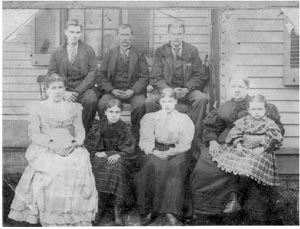
This is the only known photo of my original emigrant. That’s John Granfield in the middle of his two sons, Charles on the left and William on the right. Below them are (L-R): Mary Brazell (Mrs. William Grandfield), Delia, Mayme, and ????? (either Mary Griffin [Mrs. John Grandfield] or Mary Ellen Burns [Mrs. Thomas Brazell]). The baby is William and Mary’s first-born daughter, Mary Ellen, who later went by the name Helen Marie and became Mrs. Roy Cook.
John Gran(d)field was born 19 March 1833 according to the Catholic Parish records, but he later claimed his birthday was 12 December 1836. He was born in Ballybrack, Kerry County, Ireland, on the Dingle Peninsula. His parents were John Granfield and Bridget McCrohon. John immigrated 25 Sep 1854 to New York from Queenstown (Cork) Ireland aboard the Isaac Wright. He died 1 Nov 1910 in Cincinnati, OH from Pneumonia. A legend that was passed down is that John came over with three brothers, and all were kicked out for ringing the church bells. Wikipedia reports that in the Irish Tithe War of 1831-6, people organized resistance with signals such as ringing the chapel bells. Anyway, he had a brother William who settled in San Francisco and married Mary Jane Rodgers; a brother Thomas who settled in Virginia and married Margaret Doyle; and a sister Mary who married James Brown in Ireland and later married James Michael Houlihan in Chicopee, Massachusetts.
The name Granfield in Ireland is found almost exclusively in County Kerry, either on the Dingle Peninsula or across the bay on the famous “Ring of Kerry.” Granfields came from these places (as well as Somerset in England) to the U.S., Canada, Australia, and New Zealand.
(With thanks to Jason Grandfield in Tasmania) Apparently, Richard de Granville was the originating ancestor for our group of surnames (Gran(d)field, Granville, Grenville, Granvilia, etc.). He was a Norman knight who helped his brother, Robert Fitz Hamon, beat the local Welsh in Glamorgan and set up one of the early Marcher Lordships around 1093. In return, Richard was given the lordship of Bideford in Devon, along with a string of estates in the counties in Devon, Cornwall, Somerset and Gloucester. He was also made constable of Neath (?IIRC) in the new Welsh territory, and there are many references on the Net to him bestowing an estate near Neath to an order of monks around 1130, shortly before his death supposedly on pilgrimage to the Holy Land. The senior branch of the family became known as Grenville, and resided in Bideford right up to somewhere in the 1700’s when the male line died out. The motto of the Grenville family is “God, Country, Friends”. I imagine that the Gran(d)field branch probably broke off fairly early on, perhaps in Somerset. According to research by Niven Sinclair, Robert and Richard (and a 3rd brother called Hamon) were possibly half 2nd cousins of William the Conqueror. Their father was Hamon Dentatus, who was killed opposing William in the early days of his Norman reign (1047). However, the 3 brothers, along with 6 cousins, made up 9 “Sinclair knights” who may have rode for William at Hastings. Certainly Hamon seems to have been heavily favoured by William (appointed Sheriff of Kent and held many estates by 1086 – Domesday Book), but Robert does not seem to have come to prominence until around 1088 (made Earl of Gloucester by William II after thwarting a rebellion) and Richard only on the coat-tails of Robert. Anyway, this Sinclair research is debated by some French experts, and the theories may not be fully supported with hard evidence. As with all information taken from the Internet this should be taken with a grain of salt, but at least it’s a theory.
Thomas Granfield of Somerset, England offered the following: The Somerset Grandfields, or at least a major subset of them and the one to which I belong, were French Huguenots who arrived in England in the late 17th Century. I don’t have much information on them other than to say that Grandfield is most probably an Anglicization of Granville, the town from where we believe they were forced to leave after the 1685 Revocation of the Edict of Nantes made being a non-Catholic in France a little bit tricky (or fatal, depending on one’s luck). Much of this is family lore and not based on research but it may help clarify what you may have found so far.
I (Kevin) will add that Granville is in the same “bay” as Jersey island and St. Malo. It makes sense that the town would have changed hands between the English and French repeatedly, and alternately expelled the Catholics or Protestants, depending on who was in charge of it at the time.